Series / Product
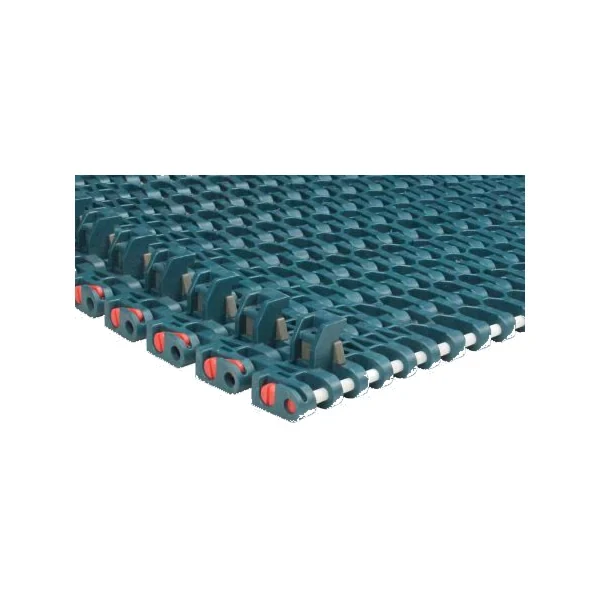
1285 Series Radius Sideflex Flat Top Belt
1285 Series Radius Sideflex Flat Top Belt for industrial conveying and replacement work, with series-specific dimensions, interface checks and RFQ guidance.
- Pitch
- 31.75 mm
- Minimum backflex radius
- 25 mm
- Minimum sideflex radii by assembly width
- 450 / 550 / 650 / 780 / 930 / 1100 / 1250 mm
- Maximum working load at 21°C
- 22,000 N
For replacement work, send the existing series/model when known plus measured width, pitch and drive-interface details. Unknown values can remain open for confirmation.
Product overview
1285 Series Radius Sideflex Flat Top Belt is presented as an industrial conveyor component for OEM, replacement and line-development work. This page keeps the series identity and available technical data together, then explains the surrounding interfaces that determine whether a replacement or new installation will fit and run correctly.
A plastic modular conveyor is a positive-drive system. The belt or chain should be selected as part of a complete mechanical interface that includes the conveyed product, support surface, shaft arrangement, sprocket position, return path, guides, transfers, temperature, cleaning regime, and accumulation behavior. A small geometric mismatch can alter articulation or tooth engagement, so purchasing decisions should be based on measured interfaces rather than visual similarity alone. For replacement work, the most useful starting information is the existing belt or chain identification, pitch, assembled width, hinge or rod arrangement, edge profile, sprocket tooth count, sprocket bore, shaft size, and clear photographs of the drive and return ends. When a legacy marking is unreadable, a dimensioned sketch and several perpendicular photographs are more reliable than one perspective image.
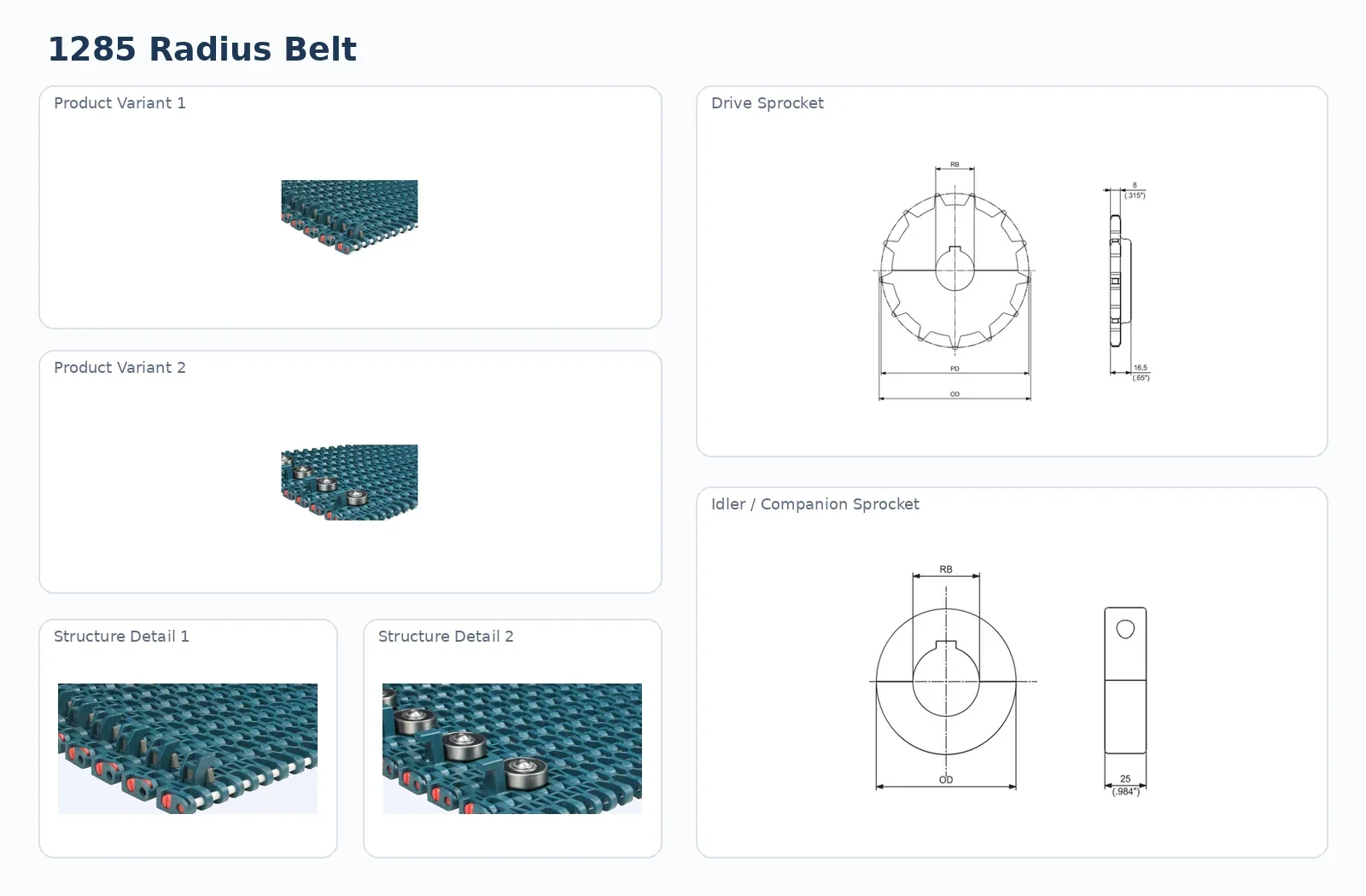
Structure and interface
直线运行系统和弧形运行系统对几何形状的要求不同。直线运行模块沿运行方向围绕链轮铰接,而弧形或侧向弯曲设计还必须适应通过受控曲线的横向铰接。切勿仅仅因为皮带宽度与框架匹配就强行使其通过曲线。
Check the hinge line, edge geometry, underside drive features and any retention elements against the existing system. Do not identify the product from color alone.
Technical specifications
Use the series-specific values below when checking fit, operating conditions and drive compatibility. Confirm project conditions before release.
| Parameter | Value |
|---|---|
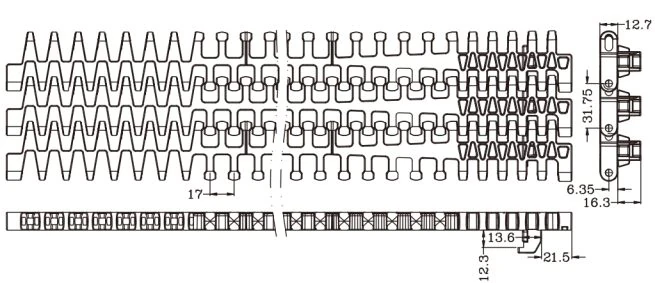
| Pitch | 31.75 mm |
| Minimum backflex radius | 25 mm |
| Minimum sideflex radii by assembly width | 450 / 550 / 650 / 780 / 930 / 1100 / 1250 mm |
| Maximum working load at 21°C | 22,000 N |
| Working temperature | 4–65 °C dry/wet |
| Weight | 8 kg/m² |
| Material code | XLG |
| Mold-part widths | 170 / 255 mm |
| Standard assembly width | W = 340 + 85 × N |
Selection checks
Confirm straight, radius, incline, accumulation and transfer duty.
Measure pitch, assembled width, hinge/rod position and any retention features.
Confirm compatible sprocket series, tooth count, bore and shaft.
State temperature, wet/dry duty, cleaning chemistry and special material needs.
操作环境至关重要,因为热塑性材料对温度、湿度、化学品、磨损和连续滑动接触的反应各不相同。应将已发布的系列值与其标明的材料代码和温度范围结合使用。不应仅因颜色相似而替换材料;颜色并非充分的材料识别方法。
Application planning
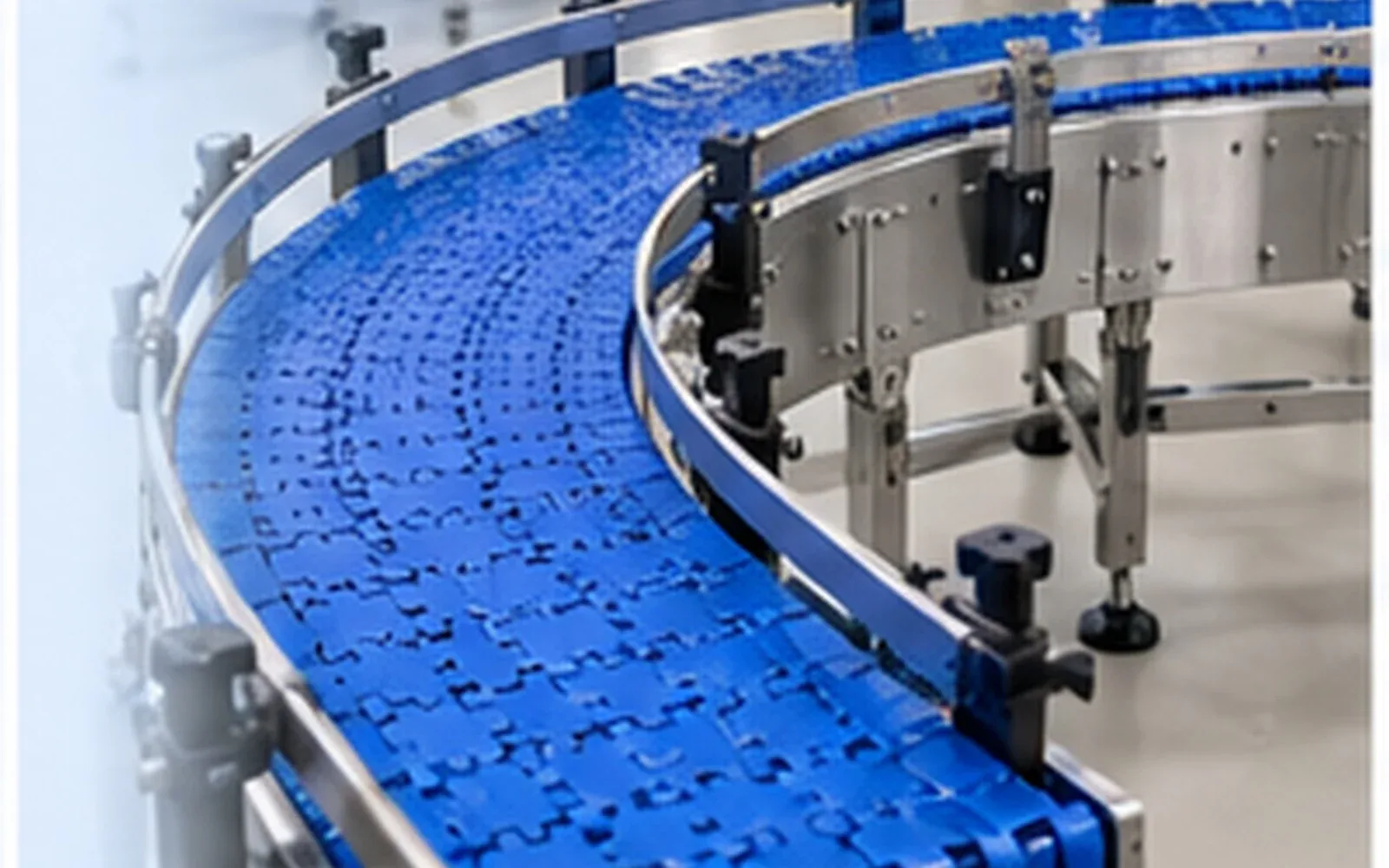
The series must be reviewed with product footprint, load, stability, speed, transfer sensitivity, accumulation and cleaning access. For curves, the side-flexing geometry and guide path become part of the selection. For straight conveyors, support and drive alignment remain equally important.
物料转移环节的设计应与长距离输送机的设计同等重视。小型或不稳定的物料可能需要梳状板、辊桥、鼻状装置或可控的死板几何形状。设计目标并非仅仅缩小可见缝隙;接口必须能够支撑物料,并避免移动模块与固定部件之间的相互干扰。
Drive and sprocket matching
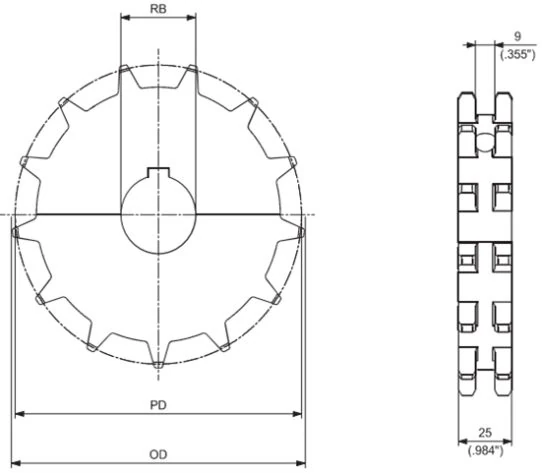
链轮提供正向驱动关系。齿数、节圆直径、孔径、轮毂或分体式结构、轴键以及轴向位置都应综合考虑。对准不良会导致载荷集中在皮带宽度的一部分上,而不合适的固定方式则会影响热胀冷缩。
Installation and commissioning
Before installation, inspect guides, supports, shafts, sprockets and transfer parts for wear or interference. Fit the belt or chain without forcing joints. Rotate the drive slowly or jog the machine at low speed to confirm clean tooth engagement across the width, stable guide contact and a controlled return path.
After loading representative product, observe transfers, curves, accumulation zones and any incline. Repeated impact, local lifting, scraping or a change in drive noise usually deserves mechanical investigation before continued production.
Inspection and maintenance
以检查为主导的维护最为有效。操作人员应监测铰链区域、连杆、导向接触、链轮啮合、异常噪音、局部磨损、物料堆积以及回油路径的任何变化。如果仅更换磨损部件而不纠正对准或污染问题,可能只会将问题转移到其他位置。
Cleaning or sanitation methods should be compatible with the selected material and with rollers, elastomers, magnets or retention features on the exact series.
RFQ preparation
对于OEM和改造项目,一份好的询价单应将已确认的数据与待解答的问题区分开来。已确认的尺寸应列明单位和测量方法。未知材料、载荷、速度或化学品暴露情况应明确标明以待确认,而非估算。
- Series or existing marking
- Pitch and assembled width
- Overall conveyor layout and curve direction
- Sprocket tooth count, bore and shaft
- Product load, speed, temperature and wet/dry conditions
- Quantity and sample/replacement/OEM status
常见问题解答
Can a replacement be selected from a photograph alone?
Photos help with identification, but pitch, width, hinge/rod geometry and the drive interface should also be measured.
Do existing sprockets need replacement?
Not always. Check series compatibility, tooth condition, bore/shaft fit and wear before reusing them.
Can material be changed independently of geometry?
Material changes can alter temperature capability, friction and wear. Use the listed options as the starting point and request confirmation for alternatives.
How should non-standard width be requested?
Send the required assembled width and the measured module increment or an existing sample. Width rules differ by series.
What speeds the quotation?
Series, pitch, width, sprocket/shaft data, application, operating conditions, quantity and drawings or clear photos.
Fit and release checks for this series
Use the available series dimensions together with the actual conveyor interfaces. The final release should identify what is confirmed and what still needs measurement.
Confirm the stated side-flex radius or radius geometry together with belt width and guide path.
Inspect inner/outer guide contact and any TAB, magnetic or retention feature against the conveyor track.
Record compatible sprocket or mounting geometry, shaft/bore information and the condition of existing mating components.
State product, load, speed, temperature, moisture, cleaning, accumulation and transfer conditions that apply to this project.
Confirmed series data to carry into the RFQ
Pitch: 31.75 mm; Minimum backflex radius: 25 mm; Minimum sideflex radii by assembly width: 450 / 550 / 650 / 780 / 930 / 1100 / 1250 mm; Maximum working load at 21°C: 22,000 N; Working temperature: 4–65 °C dry/wet; Weight: 8 kg/m². Use these values only for the exact series shown on this page; any project-specific dimension or alternative material should be confirmed before ordering.
For a replacement, add photographs of the existing top surface, underside, edge/hinge area, drive sprockets and return end. For a new machine, add the conveyor layout and the product path so support, guides and transfers can be reviewed with the selected component.
How to apply the series data on the machine
The listed values define the series, while the conveyor decides whether that series is appropriate for the project.
Machine fit
On a curved conveyor, check the actual inside guide path through the full turn and verify that the assembled width and lateral articulation match the line. The drive and return sections must transition into the curve without forcing the chain or belt sideways.
Useful confirmed values on this page include pitch 31.75 mm, minimum backflex radius 25 mm, minimum sideflex radii by assembly width 450 / 550 / 650 / 780 / 930 / 1100 / 1250 mm, maximum working load at 21°c 22,000 N, working temperature 4–65 °C dry/wet. Keep the unit and the exact parameter name with the purchasing record so the value is not separated from its meaning.
Inspection focus
Warning signs include inner-edge polishing, outer-edge lift, unstable guide contact or irregular motion through the transition between straight and curved sections.
Before reusing surrounding parts, clean and inspect the mating surfaces and drive elements. Photograph any abnormal wear before disassembly; the wear pattern can help explain why the previous component failed or became unstable.
| 查看 | 实践回顾 |
|---|---|
| Existing machine | Measure the part and the surrounding conveyor independently. Do not assume a worn component still shows the original nominal dimension. |
| New machine | Confirm machine envelope, support, drive, transfer and service access before final series release. |
| Alternative option | If material or configuration may change, state which machine dimensions are fixed and which product variables are flexible. |
| Purchase record | Keep series, width, drive/mounting data, operating conditions and any accepted drawing revision together. |
Commissioning record for 1285 Series Radius Sideflex Flat Top Belt
Confirm assembly, belt or chain seating, drive/mounting alignment and clearance to stationary parts. Rotate or jog slowly when the machine permits.
Use representative product and observe the most demanding zone: curve, accumulation, incline, transfer or return support as applicable.
Check for localized wear, new noise, edge contact, rod movement, product marks or debris concentration. Record the location of any abnormality.
Keep the final series, installed width, mating component data and operating condition with the maintenance record for future replacement.
Additional series data carried on this page includes Weight: 8 kg/m²; Material code: XLG; Mold-part widths: 170 / 255 mm; Standard assembly width: W = 340 + 85 × N. Do not detach these values from the exact series or configuration when preparing a purchase description. If the machine requires a different width, material, mounting or drive arrangement, flag the change for confirmation rather than treating it as an automatic option.
Request a series-level quotation
Send the series/model when known, measured dimensions, drive or mounting data, operating conditions, quantity and drawings or photographs. Open points can remain explicit until confirmed.