Responde primero
- Confirme la interfaz medible antes de elegir un reemplazo.
- Respete los límites de la serie publicados y específicos de la misma, así como el material y la geometría exactos.
- Registre cualquier valor desconocido como un elemento de confirmación de la solicitud de cotización en lugar de estimarlo.
The safest approach to reverse identification from measured geometry and drive parts is to treat belt, chain, sprockets, support, guides, transfers and environment as one system. Start with measured geometry and duty conditions, eliminate incompatible configurations, and only then finalize material and accessories.
1. Definir producto y proceso
Registre las dimensiones, el peso, la forma de la base, la temperatura, la estabilidad y si se prevé acumulación del producto. Añada los requisitos del proceso: lavado, drenaje, enfriamiento, calentamiento, inspección, almacenamiento temporal, fusión o transporte.
El entorno operativo es importante porque los materiales termoplásticos responden de manera diferente a la temperatura, la humedad, los productos químicos, la abrasión y el contacto deslizante continuo. Los valores de serie publicados deben utilizarse junto con sus códigos de material y rangos de temperatura indicados. No se debe sustituir un material únicamente por tener un color similar; el color no es un método suficiente para identificar un material.
2. Definir la geometría de la cinta transportadora
Los sistemas de correa recta y curva imponen diferentes exigencias geométricas. Los módulos de correa recta se articulan alrededor de las ruedas dentadas en la dirección de desplazamiento, mientras que un diseño de correa curva o de flexión lateral debe permitir también la articulación lateral a través de una curva controlada. Nunca se debe forzar una correa recta a través de una curva simplemente porque su ancho se ajuste al bastidor.
Mida las longitudes rectas, el ángulo de inclinación, el ángulo de curva, el radio interior, el ancho de la cinta transportadora, la línea central del eje, las alturas de transferencia y la trayectoria de retorno.
3. Mida la correa o cadena existente.
Para trabajos de reemplazo, la información inicial más útil es la identificación de la correa o cadena existente, el paso, el ancho ensamblado, la disposición de la bisagra o varilla, el perfil del borde, el número de dientes del piñón, el diámetro del orificio del piñón, el tamaño del eje y fotografías claras de los extremos de transmisión y retorno. Cuando una marca antigua es ilegible, un croquis acotado y varias fotografías perpendiculares son más fiables que una sola imagen en perspectiva.
4. Haga coincidir el accionamiento positivo
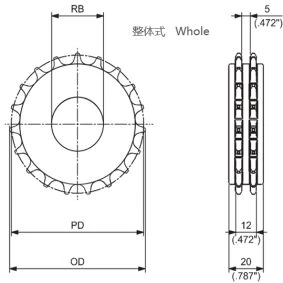
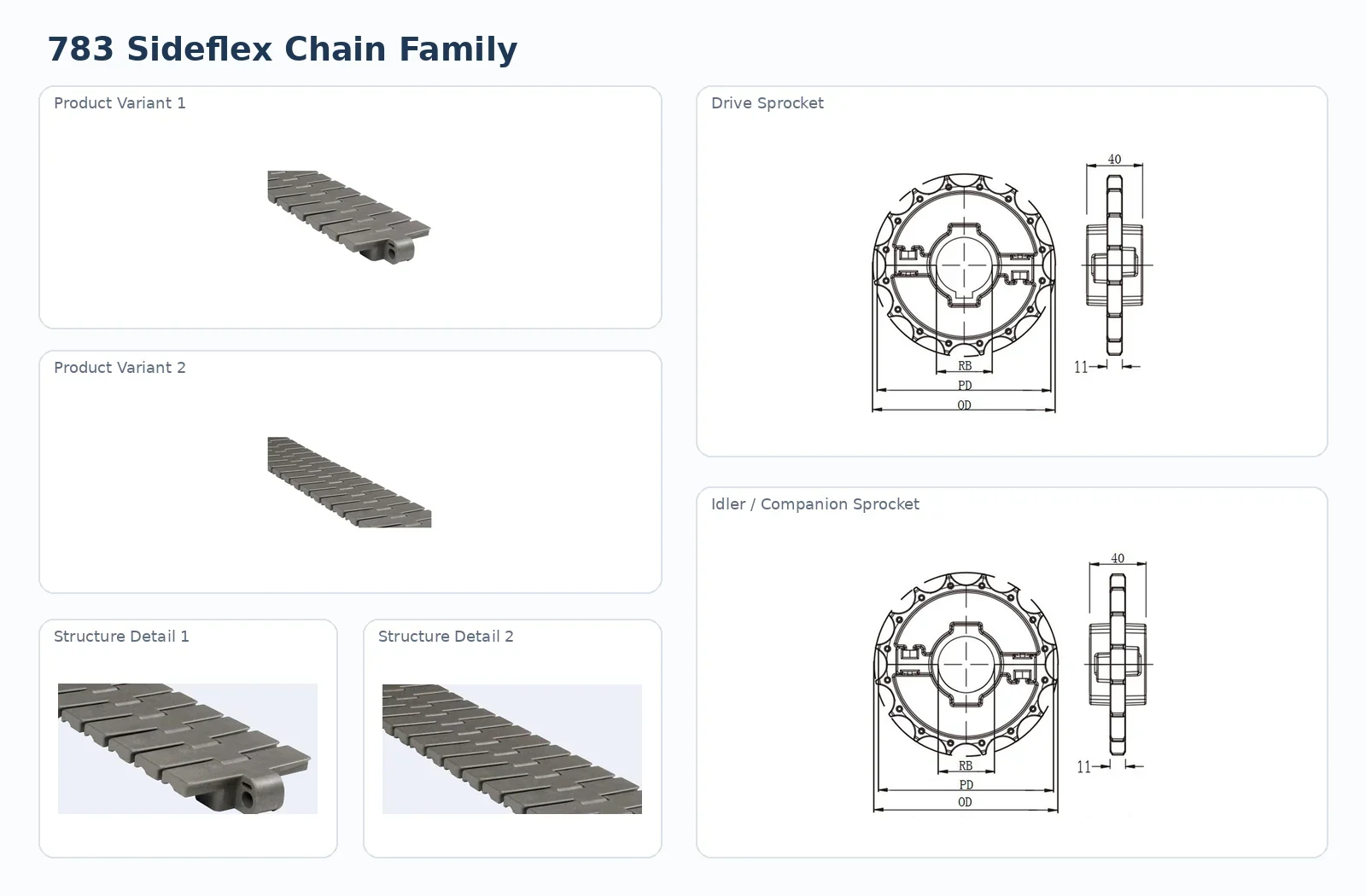
Los piñones proporcionan la transmisión positiva. Se deben revisar conjuntamente el número de dientes, el diámetro primitivo, el diámetro interior, la construcción del cubo o dividida, el chavetero del eje y la posición axial. Una mala alineación puede concentrar la carga solo en una parte del ancho de la correa, mientras que una fijación inadecuada puede interferir con la dilatación térmica.
5. Revisar el soporte, las guías y las transferencias.
Las transferencias merecen la misma atención de ingeniería que los tramos largos de la cinta transportadora. Los productos pequeños o inestables pueden requerir una placa de peine, un puente de rodillos, un sistema de soporte o una geometría controlada de la placa fija. El objetivo no es simplemente un pequeño espacio visible; la interfaz debe soportar el producto y evitar interferencias entre los módulos móviles y las piezas fijas.
| Interfaz | Verificación de ingeniería |
|---|---|
| Soporte de la calzada | La superficie de apoyo debe adaptarse a la geometría del módulo y a la carga. |
| Ruta de retorno | Evitar el hundimiento incontrolado o las interferencias. |
| Guías | Controle el producto sin desviar la correa o cadena de su trayectoria prevista. |
| Transferir | Compruebe la holgura del peine, el puente del rodillo o la placa muerta. |
| Conducir | Confirme que los dientes encajen y estén bien alineados. |
6. Puesta en marcha y mantenimiento
El mantenimiento es más eficaz cuando se basa en la inspección. Los operarios deben supervisar las zonas de las bisagras, las varillas, el contacto de las guías, el acoplamiento de las ruedas dentadas, los ruidos inusuales, el desgaste localizado, la acumulación de producto y cualquier cambio en la trayectoria de retorno. Sustituir un componente desgastado sin corregir la alineación o la contaminación puede simplemente trasladar el problema a otro lugar.
Registre la serie final instalada, los datos de la rueda dentada, la disposición del eje, las dimensiones clave y cualquier requisito especial de material o limpieza.
Lista de verificación de RFQ
Para proyectos OEM y de modernización, una buena solicitud de cotización (RFQ) distingue entre datos confirmados y preguntas sin respuesta. Las dimensiones confirmadas deben indicarse con sus unidades y método de medición. Los materiales, cargas, velocidades o exposiciones químicas desconocidas deben marcarse para su confirmación, en lugar de estimarse.
Preguntas frecuentes
¿Qué dimensión debo medir primero?
Comience con el paso y el ancho ensamblado, luego documente la línea de bisagra/varilla, el borde de la correa y la interfaz piñón/eje.
¿Es posible ampliar un dibujo a partir de una fotografía?
No es fiable a menos que exista una escala en el mismo plano. Utilice la medición directa siempre que sea posible.
¿Qué ocurre si la pieza no tiene ninguna marca legible?
Envíe varias fotos, el paso, el ancho, la geometría de la transmisión de la parte inferior, el número de dientes del piñón y el diámetro del orificio, y una muestra si es posible.
¿Debe cambiarse el material de la correa cuando la vieja se desgasta rápidamente?
Primero, identifique el mecanismo de desgaste. La alineación, el soporte, la contaminación y la temperatura pueden ser más importantes que el material.
¿Cómo puedo comparar a dos candidatos?
Compare la geometría, la función de la superficie, la carga, la temperatura, la construcción del ancho, los límites de radio/flexión hacia atrás y los requisitos de la rueda dentada/componente.
Decision framework
How to Identify an Obsolete Modular Belt: what the engineering review must decide
Use a measurement-first review. For this topic, the central issue is replacement identification and measurement discipline. The review is faster when each dimension or condition has a clear source instead of being inferred from appearance. The project record should connect the visible condition, the measured interface and the operating duty so that a proposed series can be checked against the same evidence later.
Start by identifying which parts of the system are fixed by the machine and which are still open to selection. A shaft, guide path, transfer location or process envelope may be fixed, while material, surface, exact series or component configuration can remain open. Making that distinction early prevents the engineering discussion from treating every catalogue option as interchangeable.
| Decision variable | What to document |
|---|---|
| pitch measured over multiple pitches | Record the project value or condition and note how it was confirmed before release. |
| assembled width and module increment | Record the project value or condition and note how it was confirmed before release. |
| hinge/rod line and edge profile | Record the project value or condition and note how it was confirmed before release. |
| underside drive geometry | Record the project value or condition and note how it was confirmed before release. |
| sprocket bore, tooth count and shaft details | Record the project value or condition and note how it was confirmed before release. |
Field method
Measure the interfaces that control this decision
For replacement identification and measurement discipline, the most useful field record covers pitch, width, thickness where relevant, hinge/rod axis, underside drive features, edge construction and the drive/return components in separate perpendicular views. Measurements should be taken on a clean, supported component whenever possible. If wear is present, record the worn condition and avoid treating it as the original nominal geometry.
Use direct dimensions with units and take more than one reading when wear, articulation or assembly tolerances can affect the result. A photograph should show the measuring tool in the same plane as the feature being checked; a second perpendicular photograph provides context that a single perspective image cannot. When a dimension cannot be obtained reliably, mark it as open rather than estimating it.
The machine layout matters as much as the loose part. Record the drive end, return end, guide arrangement, transfer zone and any location where the belt changes direction or experiences unusual product pressure. That context explains why two parts with similar overall dimensions may behave differently in service.
Troubleshooting
Interpret the symptom before changing the component
Wear is evidence of a contact or operating condition. Use the pattern to decide what to inspect next rather than replacing the most visible worn part automatically.
Review “estimating from a perspective photograph” against the measured conveyor interface and the operating state described in this guide. Compare drive, support, guide, return and transfer conditions, then record the specific evidence that supports the corrective action before changing the released configuration.
Record the interface dimension with units and the exact measurement point. Separate direct measurements from nominal values, and keep any unknown width increment, edge construction or mounting detail open until it can be confirmed.
Review “assuming an obsolete part interchanges from color or overall shape” against the measured conveyor interface and the operating state described in this guide. Compare drive, support, guide, return and transfer conditions, then record the specific evidence that supports the corrective action before changing the released configuration.
Review “losing units or measurement method in the purchasing handoff” against the measured conveyor interface and the operating state described in this guide. Compare drive, support, guide, return and transfer conditions, then record the specific evidence that supports the corrective action before changing the released configuration.
A single symptom rarely proves the root cause. Compare left and right sides, drive and return zones, loaded and unloaded operation, and the condition of mating parts. If a problem appears only after product accumulation, washdown, temperature change or a line-speed change, include that operating state in the investigation. This is especially important when the existing system ran acceptably before a process change.
Machine integration
Review the complete conveyor around the selected item
Use a simple sequence: confirm the product path, identify the belt or chain motion type, verify the positive-drive or mounting interface, review carry-way and return support, then check guides and transfers. The order matters because a change made to solve one zone can create a new interference or wear point elsewhere.
For this article, a representative review scenario is a replacement project where the original part number is unreadable and the engineering review must identify the belt from measured interfaces and photographs. The technical review should therefore include the most demanding zone, not only the longest straight span. Where the product changes direction, accumulates, enters a transfer or experiences washdown, note the local geometry and the component that carries or constrains the load.
Keep safety guarding, access and the machine maker’s procedures outside the component-selection assumptions. The conveyor component data can support fit and operating review, but machine-level safety and commissioning remain part of the equipment design and site procedure.
Worked review
How to compare alternatives without inventing missing data
Assume the current line has a known product path and an existing component that may need replacement. First, write down the values that are physically measured or clearly identified. Next, list the parameters that come from the exact candidate series. Keep those two groups separate. A published material or operating value belongs to the candidate series; a shaft diameter, guide spacing or installed width belongs to the machine.
Then compare the fixed interfaces with each candidate. Reject an option when a required geometry is incompatible rather than trying to compensate with guide pressure, forced articulation or an improvised sprocket. If several options remain, compare the functional differences that matter to the process: contact surface, open area, rolling or gripping function, curve capability, transfer behavior, cleaning access or component serviceability. The choice should be traceable to the process requirement rather than to color or appearance.
Finally, identify what would still have to be confirmed before order release. The open item might be a material requirement, a drawing dimension, a bore/keyway detail, an exact installed width or an operating exposure. State who will confirm it and by what evidence. This makes the quotation useful even before every question is closed and avoids hiding uncertainty inside an assumed specification.
Procurement handoff
Build a purchase description that can be checked later
The handoff should preserve the relationship between the selected component and the machine. For this topic, keep dimensioned sketch, perpendicular photographs, physical sample when available, drive data, operating conditions and quantity together in the RFQ or purchase record. Attach the layout or photographs used for the decision and identify any accepted alternative rather than relying on an informal description such as “same as existing.”
| Record | Purpose |
|---|---|
| Component identity | Series/model or the measured identification basis when the marking is unavailable. |
| Machine interface | Dimensions, shaft/mounting, guides, support, transfer and surrounding fixed geometry relevant to the topic. |
| Operating duty | Product/load, speed context, temperature, wet/dry condition, cleaning or other process exposure that affects selection. |
| Puntos abiertos | Items that still require a drawing, sample, second measurement or engineering confirmation. |
| Revision record | The final accepted drawing, series/configuration and any change from the previous installation. |
This record is also valuable for maintenance. If the conveyor is modified later, the team can see which assumptions belonged to the original selection and decide whether the changed product, speed, guide path, cleaning process or transfer geometry requires a fresh review.
Commissioning
Check the first run against the engineering assumptions
When the machine procedure permits, begin with an unloaded or lightly loaded check. Observe the drive or mounting interface, guide contact, carry-way support, return path and clearances to stationary parts. Then introduce representative product and watch the zone that drove the selection decision. The objective is to verify that the installed behavior matches the assumptions documented during selection.
Listen for new cyclic noise and inspect for localized rubbing, lifting, rod movement, edge contact, product marking or debris concentration. A small early change can be easier to correct before it becomes a wear pattern. Record the first inspection condition so later maintenance has a baseline rather than relying on memory.
If the result differs from the expected behavior, return to the measured interface and operating condition before changing material or series again. A component change cannot correct a misaligned shaft, an interfering guide or a transfer that physically constrains the belt outside its intended articulation.
Release checklist
Questions to close before ordering
- Is the exact motion type or component function identified?
- Are the controlling machine dimensions recorded with units?
- Are mating sprockets, shafts, guides, supports or transfer parts documented?
- Are product, load and operating conditions representative of actual duty?
- Are material or special-process requirements tied to the exact series rather than inferred?
- Are worn or modified surrounding parts identified separately from the proposed replacement?
- Are all unknown values explicitly listed for confirmation?
- Does the RFQ include quantity plus clear drawings, photographs or a sample when available?
Closing these questions produces a stronger engineering request and reduces the chance that a quotation is based on visual similarity alone. If a value remains unknown, leave it open and state the evidence needed to close it; do not invent a number to make the request appear complete.