Zuerst antworten
- Prüfen Sie die messbare Schnittstelle, bevor Sie einen Ersatz auswählen.
- Halten Sie die serienspezifischen, veröffentlichten Serienbegrenzungen für das exakte Material und die Geometrie ein.
- Unbekannte Werte werden als RFQ-Bestätigungsposition erfasst, anstatt sie zu schätzen.
The safest approach to selection variables and a disciplined screening sequence is to treat belt, chain, sprockets, support, guides, transfers and environment as one system. Start with measured geometry and duty conditions, eliminate incompatible configurations, and only then finalize material and accessories.
1. Produkt und Prozess definieren
Produktabmessungen, Gewicht, Grundform, Temperatur, Stabilität und zu erwartende Ablagerungen erfassen. Prozessanforderungen hinzufügen: Waschen, Abtropfen, Kühlen, Erhitzen, Prüfen, Puffern, Zusammenführen oder Transportieren.
Die Betriebsumgebung ist wichtig, da thermoplastische Werkstoffe unterschiedlich auf Temperatur, Feuchtigkeit, Chemikalien, Abrieb und kontinuierliche Gleitbeanspruchung reagieren. Die veröffentlichten Serienwerte sollten zusammen mit den angegebenen Materialcodes und Temperaturbereichen verwendet werden. Ein Werkstoff sollte nicht allein aufgrund einer ähnlichen Farbe ausgetauscht werden; die Farbe ist kein ausreichendes Kriterium zur Materialidentifizierung.
2. Förderbandgeometrie definieren
Gerade und gebogene Riemensysteme stellen unterschiedliche geometrische Anforderungen. Gerade Riemenmodule bewegen sich in Fahrtrichtung um die Kettenräder, während gebogene oder seitlich flexible Konstruktionen zusätzlich eine seitliche Bewegung in einer kontrollierten Kurve ermöglichen müssen. Ein gerader Riemen sollte niemals nur deshalb durch eine Kurve gezwungen werden, weil seine Breite zum Rahmen passt.
Messen Sie gerade Längen, Neigungswinkel, Kurvenwinkel, Innenradius, Förderbandbreite, Schachtmittellinie, Übergabehöhen und Rücklaufweg.
3. Vorhandenen Riemen oder Kette messen.
Für Austauscharbeiten sind die wichtigsten Ausgangsinformationen die vorhandene Riemen- oder Kettenbezeichnung, Teilung, Gesamtbreite, Gelenk- oder Stangenanordnung, Kantenprofil, Zähnezahl des Kettenrads, Kettenradbohrung, Wellendurchmesser und deutliche Fotos der Antriebs- und Rücklaufseite. Ist eine alte Kennzeichnung unleserlich, sind eine bemaßte Skizze und mehrere senkrechte Fotos zuverlässiger als eine einzelne perspektivische Aufnahme.
4. Passen Sie den positiven Antrieb an.
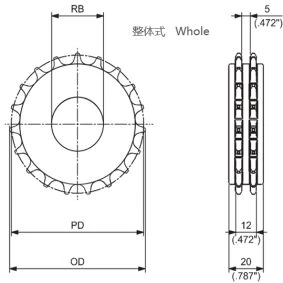
Kettenräder stellen die formschlüssige Kraftübertragung her. Zähnezahl, Teilkreisdurchmesser, Bohrung, Naben- oder geteilte Konstruktion, Wellenpassung und axiale Position sollten gemeinsam geprüft werden. Eine mangelhafte Ausrichtung kann die Last nur auf einen Teil der Riemenbreite konzentrieren, während eine ungeeignete Befestigung die thermische Ausdehnung beeinträchtigen kann.
5. Überprüfen Sie Support, Anleitungen und Transfers
Übergabeprozesse erfordern dieselbe technische Sorgfalt wie die Durchführung langer Förderbandstrecken. Kleine oder instabile Produkte benötigen unter Umständen eine Kammplatte, eine Rollenbrücke, eine spezielle Vorrichtung oder eine kontrollierte Totplattengeometrie. Ziel ist nicht nur ein kleiner, sichtbarer Spalt; die Schnittstelle muss das Produkt stützen und Kollisionen zwischen beweglichen Modulen und stationären Teilen vermeiden.
| Schnittstelle | Technische Prüfung |
|---|---|
| Tragehilfe | Die Auflagefläche muss der Geometrie und Belastung des Moduls angepasst sein. |
| Rückweg | Unkontrolliertes Durchhängen oder Störungen vermeiden. |
| Leitfäden | Produkt steuern, ohne Riemen/Kette aus ihrem vorgesehenen Verlauf zu zwingen. |
| Überweisen | Prüfen Sie den Abstand zwischen Kamm, Rollenbrücke und Totplatte. |
| Fahren | Sicherstellen, dass die Zähne sauber ineinandergreifen und richtig ausgerichtet sind. |
6. Inbetriebsetzen und warten
Die Instandhaltung ist am effektivsten, wenn sie inspektionsgeleitet erfolgt. Die Bediener sollten Scharnierbereiche, Stangen, Führungskontakte, Kettenradeingriffe, ungewöhnliche Geräusche, lokalen Verschleiß, Produktablagerungen und jegliche Veränderungen im Rücklaufweg überwachen. Der Austausch eines verschlissenen Bauteils ohne Korrektur von Ausrichtung oder Verschmutzung kann das Problem lediglich verlagern.
Notieren Sie die endgültig installierte Baureihe, die Kettenraddaten, die Wellenanordnung, die wichtigsten Abmessungen sowie alle besonderen Material- oder Reinigungsanforderungen.
Checkliste für Angebotsanfragen
Bei OEM- und Nachrüstungsprojekten trennt eine gute Angebotsanfrage bestätigte Daten von offenen Fragen. Bestätigte Abmessungen sollten mit Einheiten und Messmethode aufgeführt werden. Unbekannte Materialien, Belastungen, Geschwindigkeiten oder chemische Einflüsse sollten zur Bestätigung gekennzeichnet und nicht geschätzt werden.
Häufig gestellte Fragen
Welche Dimension sollte ich zuerst messen?
Beginnen Sie mit der Teilung und der Gesamtbreite, dokumentieren Sie dann die Scharnier-/Stangenlinie, die Riemenkante und die Schnittstelle zwischen Kettenrad und Welle.
Kann eine Zeichnung anhand eines Fotos skaliert werden?
Unzuverlässig ist dies nur, wenn eine Skala in derselben Ebene vorhanden ist. Verwenden Sie nach Möglichkeit direkte Messungen.
Was ist, wenn das Teil keine lesbare Kennzeichnung aufweist?
Bitte senden Sie mehrere Fotos, Angaben zu Teilung, Breite, Geometrie des Antriebs von unten, Anzahl der Kettenradzähne und Bohrung sowie nach Möglichkeit ein Muster.
Sollte das Material gewechselt werden, wenn der alte Riemen schnell verschleißt?
Identifizieren Sie zunächst den Verschleißmechanismus. Ausrichtung, Unterstützung, Verschmutzung und Temperatur können wichtiger sein als das Material.
Wie vergleiche ich zwei Kandidaten?
Vergleichen Sie Geometrie, Oberflächenfunktion, Belastung, Temperatur, Breitenkonstruktion, Radius-/Rückbiegungsgrenzen und Anforderungen an Kettenrad/Komponente.
Decision framework
Plastic Modular Belt Selection Checklist: what the engineering review must decide
Begin with the machine, not the catalogue page. For this topic, the central issue is a disciplined plastic-conveyor selection process. The useful question is whether the proposed component fits the actual conveyor interfaces and duty. The project record should connect the visible condition, the measured interface and the operating duty so that a proposed series can be checked against the same evidence later.
Start by identifying which parts of the system are fixed by the machine and which are still open to selection. A shaft, guide path, transfer location or process envelope may be fixed, while material, surface, exact series or component configuration can remain open. Making that distinction early prevents the engineering discussion from treating every catalogue option as interchangeable.
| Decision variable | What to document |
|---|---|
| conveyor geometry | Record the project value or condition and note how it was confirmed before release. |
| product and load | Record the project value or condition and note how it was confirmed before release. |
| belt/chain dimensions | Record the project value or condition and note how it was confirmed before release. |
| drive/support interfaces | Record the project value or condition and note how it was confirmed before release. |
| operating environment | Record the project value or condition and note how it was confirmed before release. |
Field method
Measure the interfaces that control this decision
For a disciplined plastic-conveyor selection process, the most useful field record covers the conveyor layout, product data, belt/chain dimensions, drive components and the most demanding operating condition. Measurements should be taken on a clean, supported component whenever possible. If wear is present, record the worn condition and avoid treating it as the original nominal geometry.
Use direct dimensions with units and take more than one reading when wear, articulation or assembly tolerances can affect the result. A photograph should show the measuring tool in the same plane as the feature being checked; a second perpendicular photograph provides context that a single perspective image cannot. When a dimension cannot be obtained reliably, mark it as open rather than estimating it.
The machine layout matters as much as the loose part. Record the drive end, return end, guide arrangement, transfer zone and any location where the belt changes direction or experiences unusual product pressure. That context explains why two parts with similar overall dimensions may behave differently in service.

Fehlerbehebung
Interpret the symptom before changing the component
Wear is evidence of a contact or operating condition. Use the pattern to decide what to inspect next rather than replacing the most visible worn part automatically.
Compare the actual pitch, assembled width, articulation, underside drive geometry and edge profile before accepting a visual match. Similar color or top-surface shape is not enough to prove interchangeability.
Measure the interfaces that control fit and engagement, record the units and measurement points, and keep nominal assumptions separate from direct measurements. Missing values should stay open until confirmed.
Inspect sprocket teeth, shaft alignment, guides, wear strips, return supports and transfer parts for localized wear. A new moving component can reproduce the same symptom if the mating hardware remains damaged.
Review the belt or chain together with the drive, support, guide, return and transfer geometry. Confirm the operating condition that produced the symptom before changing the released configuration.
A single symptom rarely proves the root cause. Compare left and right sides, drive and return zones, loaded and unloaded operation, and the condition of mating parts. If a problem appears only after product accumulation, washdown, temperature change or a line-speed change, include that operating state in the investigation. This is especially important when the existing system ran acceptably before a process change.
Machine integration
Review the complete conveyor around the selected item
Use a simple sequence: confirm the product path, identify the belt or chain motion type, verify the positive-drive or mounting interface, review carry-way and return support, then check guides and transfers. The order matters because a change made to solve one zone can create a new interference or wear point elsewhere.
For this article, a representative review scenario is an OEM or maintenance team comparing a new or replacement component while several interface dimensions are still open. The technical review should therefore include the most demanding zone, not only the longest straight span. Where the product changes direction, accumulates, enters a transfer or experiences washdown, note the local geometry and the component that carries or constrains the load.
Keep safety guarding, access and the machine maker’s procedures outside the component-selection assumptions. The conveyor component data can support fit and operating review, but machine-level safety and commissioning remain part of the equipment design and site procedure.
Worked review
How to compare alternatives without inventing missing data
Assume the current line has a known product path and an existing component that may need replacement. First, write down the values that are physically measured or clearly identified. Next, list the parameters that come from the exact candidate series. Keep those two groups separate. A published material or operating value belongs to the candidate series; a shaft diameter, guide spacing or installed width belongs to the machine.
Then compare the fixed interfaces with each candidate. Reject an option when a required geometry is incompatible rather than trying to compensate with guide pressure, forced articulation or an improvised sprocket. If several options remain, compare the functional differences that matter to the process: contact surface, open area, rolling or gripping function, curve capability, transfer behavior, cleaning access or component serviceability. The choice should be traceable to the process requirement rather than to color or appearance.
Finally, identify what would still have to be confirmed before order release. The open item might be a material requirement, a drawing dimension, a bore/keyway detail, an exact installed width or an operating exposure. State who will confirm it and by what evidence. This makes the quotation useful even before every question is closed and avoids hiding uncertainty inside an assumed specification.
Procurement handoff
Build a purchase description that can be checked later
The handoff should preserve the relationship between the selected component and the machine. For this topic, keep series/model, measured dimensions, drive and support details, operating conditions, quantity and clear drawings or photographs together in the RFQ or purchase record. Attach the layout or photographs used for the decision and identify any accepted alternative rather than relying on an informal description such as “same as existing.”
| Record | Purpose |
|---|---|
| Component identity | Series/model or the measured identification basis when the marking is unavailable. |
| Machine interface | Dimensions, shaft/mounting, guides, support, transfer and surrounding fixed geometry relevant to the topic. |
| Betriebspflicht | Product/load, speed context, temperature, wet/dry condition, cleaning or other process exposure that affects selection. |
| Offene Punkte | Items that still require a drawing, sample, second measurement or engineering confirmation. |
| Revision record | The final accepted drawing, series/configuration and any change from the previous installation. |
This record is also valuable for maintenance. If the conveyor is modified later, the team can see which assumptions belonged to the original selection and decide whether the changed product, speed, guide path, cleaning process or transfer geometry requires a fresh review.
Commissioning
Check the first run against the engineering assumptions
When the machine procedure permits, begin with an unloaded or lightly loaded check. Observe the drive or mounting interface, guide contact, carry-way support, return path and clearances to stationary parts. Then introduce representative product and watch the zone that drove the selection decision. The objective is to verify that the installed behavior matches the assumptions documented during selection.
Listen for new cyclic noise and inspect for localized rubbing, lifting, rod movement, edge contact, product marking or debris concentration. A small early change can be easier to correct before it becomes a wear pattern. Record the first inspection condition so later maintenance has a baseline rather than relying on memory.
If the result differs from the expected behavior, return to the measured interface and operating condition before changing material or series again. A component change cannot correct a misaligned shaft, an interfering guide or a transfer that physically constrains the belt outside its intended articulation.
Release checklist
Questions to close before ordering
- Is the exact motion type or component function identified?
- Are the controlling machine dimensions recorded with units?
- Are mating sprockets, shafts, guides, supports or transfer parts documented?
- Are product, load and operating conditions representative of actual duty?
- Are material or special-process requirements tied to the exact series rather than inferred?
- Are worn or modified surrounding parts identified separately from the proposed replacement?
- Are all unknown values explicitly listed for confirmation?
- Does the RFQ include quantity plus clear drawings, photographs or a sample when available?
Closing these questions produces a stronger engineering request and reduces the chance that a quotation is based on visual similarity alone. If a value remains unknown, leave it open and state the evidence needed to close it; do not invent a number to make the request appear complete.